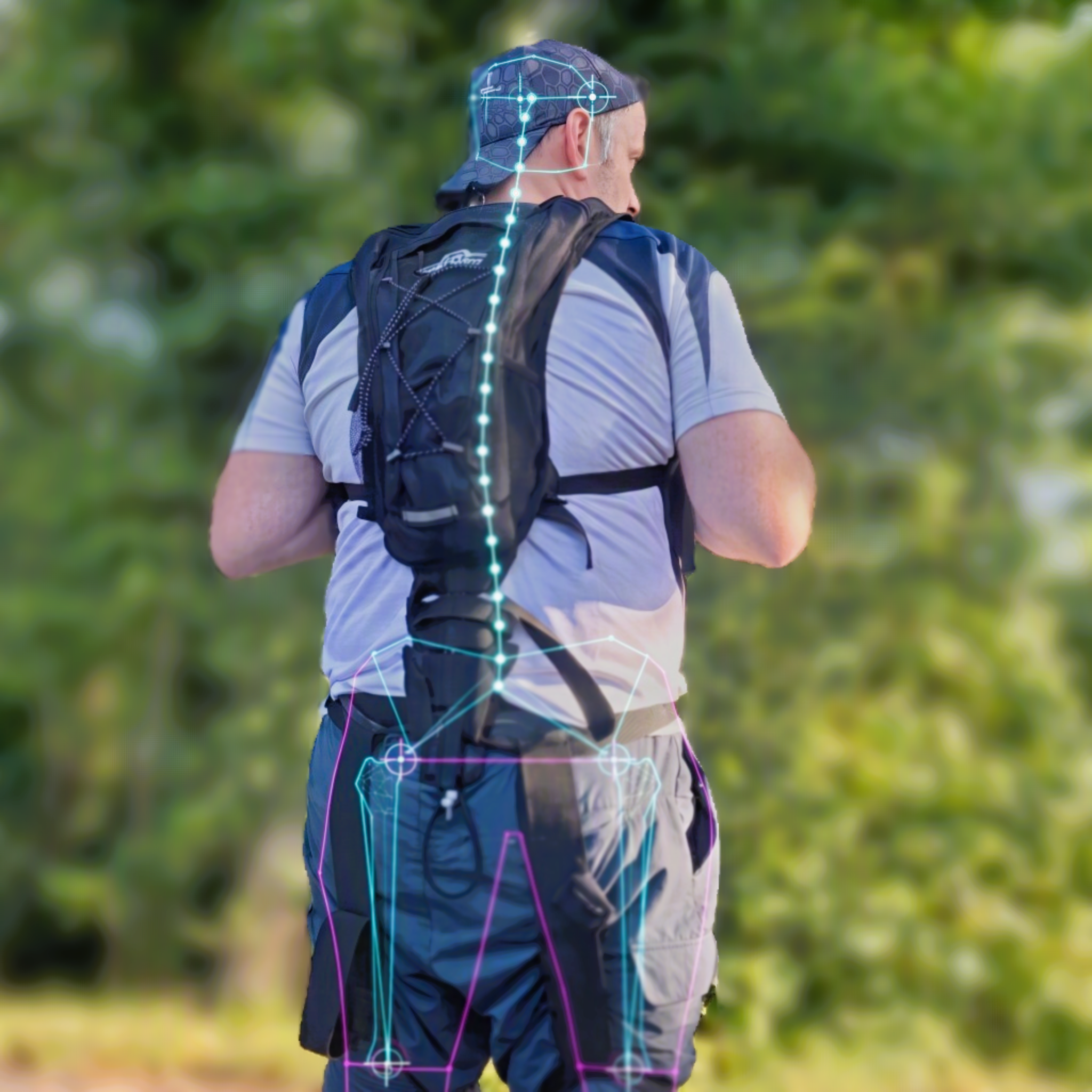
Project Nora, our lightweight passive exoskeleton built to protect the lower back and extend endurance in demanding environments, has officially progressed to its next major phase. Having proven itself in real-world alpine and field trials, Nora is now moving into comprehensive lab-based testing.
Why lab-based testing matters
Field trials tell us how Nora performs in the environments it's built for. Lab-based testing tells us something different: how it performs against the rigorous, repeatable benchmarks defined by ASTM's exoskeleton standards. It's a controlled complement to real-world data, and a required step before a device like Nora can be confidently deployed at scale.
- Structural and load-bearing testing against ASTM exoskeleton standards
- Repeatable, controlled validation to complement our alpine field trials
- Documentation and testing structured to support future certification
What's next
Lab testing will run over the coming months, with results feeding directly back into Nora's design. We'll share progress as testing phases are completed.
Project NORA Enters the Lab: Designing for International Compliance & Best Practice
The development of Project NORA has entered a crucial new phase with the commencement of active laboratory testing. Beyond verifying core system mechanics, this stage is dedicated to proving that the design of Project NORA fully complies with recognized international standards, reflecting true industry best practice from the ground up.
Rather than retrofitting compliance late in the development cycle, embedding global standard practices into our active testing framework ensures that safety, documentation, and performance validation are built into the design process itself.
Our baseline testing program currently integrates two foundational ASTM standards:
1. Design & Labeling Compliance (ASTM F3358)
Adopting ASTM F3358 (Standard Practice for Labeling and Information for Exoskeletons) guarantees that operational parameters, safety boundaries, and user guidance comply with established international frameworks. Structuring system information against this standard early ensures operational transparency, reduces friction, and prepares the technology for seamless real-world adoption.
2. Environmental Documentation & Test Rigor (ASTM F3427)
To ensure test results meet international benchmarks for data integrity, we utilize ASTM F3427 (Standard Practice for Documenting Environmental Conditions for Utilization with Exoskeleton Test Methods). Logically capturing environmental variables, such as ambient temperature, humidity, and surface characteristics, ensures that every dataset generated in the lab is reproducible, traceable, and objectively verified.
Setting the Industry Benchmark
Designing for compliance from day one reflects Project NORA's commitment to engineering excellence. As laboratory testing progresses, these standardized protocols ensure our technology is robust, validated, and built to the highest global standards.
Taking NORA to Ben Nevis: Real-World Endurance Testing for a Cause
Lab benchmarks and controlled load sweeps tell us how Project NORA performs against ASTM standards. This October, we're putting it back where the idea started: on the mountain. Three of us from Viking Exos, Matthew Dickinson, Ben Cordery, and Jan Dickinson, are climbing Ben Nevis, the highest peak in the British Isles, with one team member wearing NORA the entire way up.
It's an unscripted, single-session endurance test in exactly the kind of unforgiving alpine terrain NORA was designed for: steep, technical, weather-exposed, and unforgiving of anything that isn't built to hold up under sustained load. Whatever conditions October throws at us, the climb will add a genuine field data point to the structural and lab-based work already underway.
We're using the climb to raise money for Lochaber Mountain Rescue Team, Scotland's busiest rescue team, who carry out more than 150 rescues a year on Ben Nevis and the surrounding terrain, entirely volunteer-run and funded by public donations. It felt like the right cause to pair with a device built to support people carrying heavy loads through difficult, high-consequence terrain.
If you'd like to support the climb and help a team that saves lives on that mountain, you can donate directly, and we'll be sharing updates from the climb itself once we're back down.
Support the climb and Lochaber Mountain Rescue Team
Donate on JustGivingWant the full technical breakdown of Project NORA?
Subscribe to development updates and get instant access to our complete whitepaper, covering engineering, field trials, and ASTM compliance testing in full.
Developing your own wearable device and need support navigating ASTM standards?
Learn About Our Standards Consultation